Environment Agency Carrier Dealer – Upper Tier · CBDU418527
Waste Transfer Note issued on every job
£5m public liability insurance
020 3504 6427
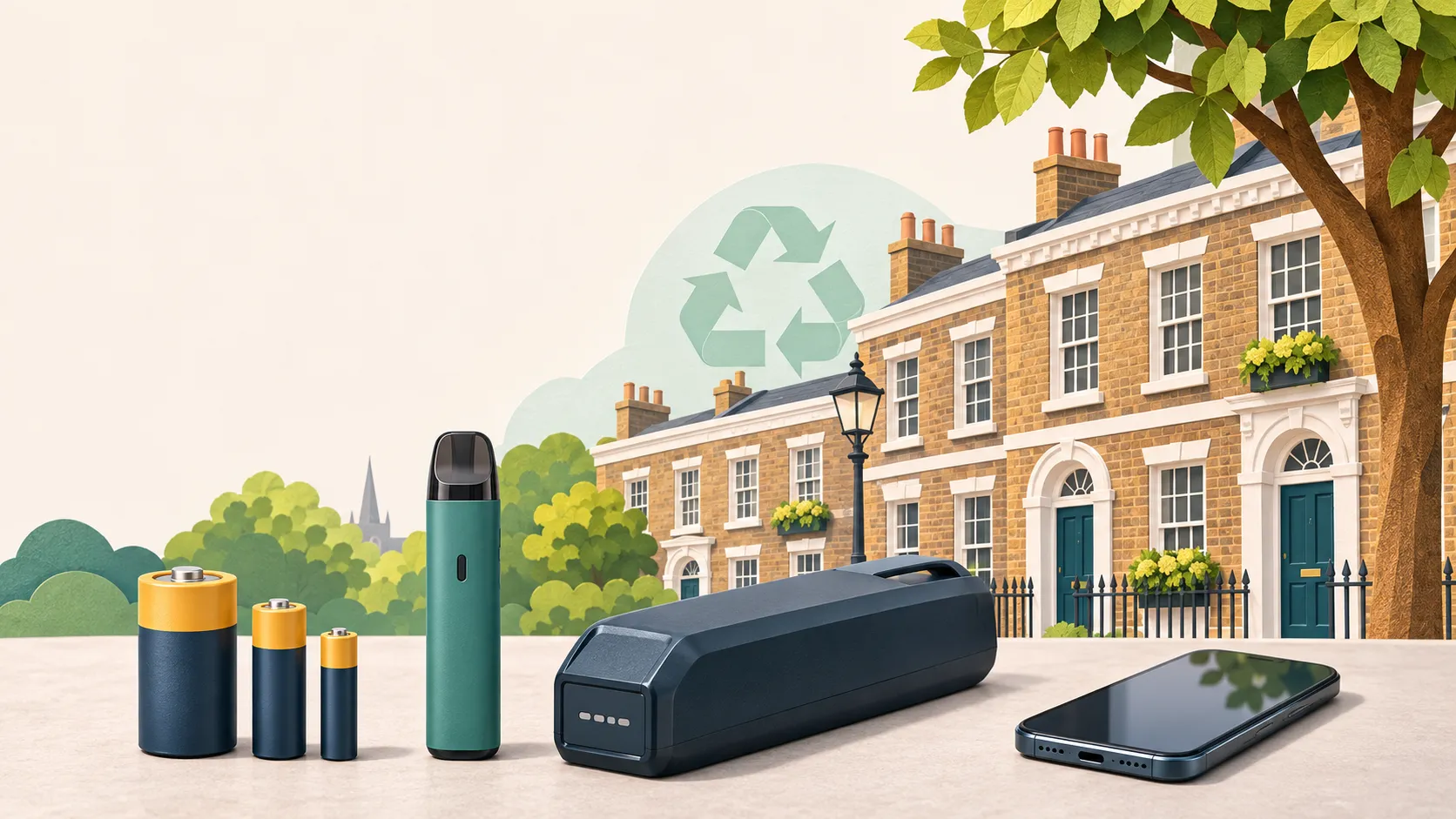
Old batteries, used vapes and broken rechargeable gadgets should never disappear into a bag of household rubbish. In Islington, there are dedicated ways to recycle them, including retailer schemes, Hornsey Street recycling centre and a council-listed home collection service.
The first step is identifying what you have. A loose household battery, a whole vape and an e-scooter battery pack may need different arrangements. A damaged battery needs extra care.
This guide explains the local options for residents in Islington, including Angel, Barnsbury, Canonbury, Highbury and Holloway. It also includes useful council resources for neighbouring Camden and Hackney.
Key points
Lithium-ion batteries power everyday items such as phones, laptops, cordless tools, electric toothbrushes, vapes and e-bikes. Their small size can make them easy to overlook when clearing drawers, cupboards or a property.
If these batteries are crushed or damaged during waste handling, they can catch fire. Putting an electrical item into ordinary household recycling does not solve that problem: it still enters a collection and sorting system that is not intended for it.
North London Waste Authority's Lead the Charge campaign explains why battery-powered products need a separate recycling route.
Keep batteries and battery-containing electricals out of normal household rubbish and recycling bins.
There is a confirmed local example of the risk. According to NLWA's account of the Christmas Eve 2025 fire, a lithium-ion battery incorrectly placed in household waste ignited after a loading vehicle drove over it at Hornsey Street Waste Transfer Station. The transfer station and adjacent public recycling centre were evacuated.
Another major fire occurred on 28 July 2026. Islington Council's statement reports that 15 fire engines and around 100 firefighters attended, with no injuries reported. The statement did not confirm the cause.
These incidents should not be confused. The December fire was attributed to a battery by NLWA; the July fire should not be described as a confirmed battery fire on the evidence in those statements.
In its 5 August 2026 update, NLWA reported 20 lithium-ion battery fires across its sites during 2025 and six during 2026 up to that statement. These are north London figures, not an Islington-only total.
Choose a route that accepts your particular item. Do not assume that every battery box or small-electrical bank accepts whole vapes, larger battery packs or damaged batteries.
| What you have | Where to start |
|---|---|
| Ordinary loose household batteries | Use a suitable household battery collection point, checking the accepted types. |
| A used vape with its battery inside | Use a vape retailer take-back scheme, an appropriate recycling-centre route or Islington's listed collection service. |
| A phone, electric toothbrush or other rechargeable device | Use an electrical recycling route. Follow instructions for any safely removable battery. |
| An e-bike or e-scooter battery pack | Contact the retailer, manufacturer or recycling service first to confirm acceptance and handling instructions. |
| A swollen, leaking or otherwise damaged battery | Seek specific advice before handling or transport; do not put it into a routine collection box. |
Larger electricals such as washing machines, fridges and cookers are a different job. See our appliance removal service, which collects white goods and takes them for recycling under the WEEE regulations.
The local centre is at:
40 Hornsey Street
Islington
London N7 8HU
Telephone: 020 7464 2225
Check the official Hornsey Street page before travelling for current opening hours, access requirements and restrictions.
Islington explains that pedestrians and cyclists use a drop-off point at the entrance rather than entering the centre itself. Some materials are excluded from that drop-off point.
Check the council's visiting guidance, especially if bringing anything unusual.
Islington Council's electrical recycling page currently lists a free bookable home collection covering electrical items, household batteries and vapes, with collections on Thursdays.
Use the booking link on that council page and check the service's current conditions. Do not assume the household collection automatically covers large e-bike packs or damaged batteries.
Many supermarkets and other battery retailers provide collection points for portable household batteries. Check the collection box's instructions for accepted types.
Government battery recycling guidance advises that lithium battery terminals should ideally be taped to reduce fire risk. This is preparation for suitable, intact batteries, not a way to make a failing battery safe.
An item with a battery that cannot be removed should be treated as an electrical product.
Recycle the whole device through a suitable vape collection route if its battery does not come out easily. Do not force it open to extract the battery.
NLWA's vape guidance explains retailer take-back options and recycling-centre arrangements. Follow the instructions at the receiving location rather than dropping a vape into whichever recycling container is nearest.
Vape retailers must offer take-back arrangements for recycling. Government guidance also confirms that this includes old single-use vapes returned after the sales ban began.
The fact that a vape is empty or no longer works does not make it suitable for household rubbish.
Treat a larger battery pack as a separate enquiry. Do not assume a supermarket box, street electrical bank or routine rubbish collection can accept it.
London Fire Brigade's disposal advice directs residents to local authority information and appropriate electrical recycling routes.
Before taking a pack anywhere, describe its type and condition to the receiving service. Ask whether it is accepted and how it should be prepared.
Do not dismantle the battery pack yourself.
London Fire Brigade identifies the following warning signs:
Stop using the device. If safe, switch it off and disconnect it from charging, then contact the manufacturer or retailer for instructions. Do not handle an unsafe device just to prepare it for recycling.
If a battery starts smoking or catches fire, get out, raise the alarm and call 999. Do not try to tackle the fire yourself.
Read London Fire Brigade's full warning-sign guidance.
An actively failing battery is an emergency, not an ordinary disposal appointment.
When arranging rubbish clearance in Islington, tell MM Rubbish Clearance about loose batteries, vapes, rechargeable tools and battery-powered equipment before collection.
Our responsible rubbish clearance guidance asks customers to declare lithium-ion products and tell us about damaged or swollen batteries.
For a house or flat clearance in Islington, include these items in your enquiry rather than hiding them in bags of mixed rubbish. Identify battery-powered items in your photos where it is safe to do so.
Sending an enquiry does not confirm acceptance of a battery or specialist item. The suitable collection or disposal route needs to be agreed first.
Still-working electricals may not need to be thrown away at all. Our guide to donating, reusing and recycling in London covers reuse options and electrical drop-off points.
Clearing a flat or house in Islington? Send photos and your postcode, and list any batteries, vapes or battery-powered items so we can agree the right route before we arrive.
Residents in the nearby parts of Camden and Hackney should use their own council's guidance for local services.
Camden's household battery recycling guidance covers collection points and battery collections available to some homes.
Its electrical and vape recycling page identifies Regis Road recycling centre and take-back options.
Hackney's recycling-bank guidance lists local banks that accept household batteries and small electricals, and notes that many supermarkets take empty vapes, so check with your local store.
Check what each location accepts before taking batteries, vapes or rechargeable equipment there.
No. Batteries need a dedicated recycling route. Putting them into household recycling can expose them to crushing or damage during collection and processing.
Not in ordinary rubbish or household recycling. An empty vape still contains electrical components and usually a battery. Use an appropriate vape recycling or take-back service.
Only if it comes out easily and safely. Do not force open the device. Where the battery is built in, use a recycling route that accepts the whole vape.
The council currently lists a free bookable home collection covering household batteries and vapes. Check its electrical recycling page for current booking conditions.
Declare it before booking so the appropriate route can be checked. Do not assume that a furniture or general rubbish collection includes large battery packs or damaged batteries.
Use Islington Council's battery and electrical recycling information. Identify the item, check that the receiving service accepts it and follow its preparation instructions.
Local service information checked on 10 November 2026. Check the linked council and recycling-centre pages before booking or travelling.
